Blog
BlogThe performance paradox: The technology trap, national capabilities and transformation
6 min read Written by: Micheal Stephenson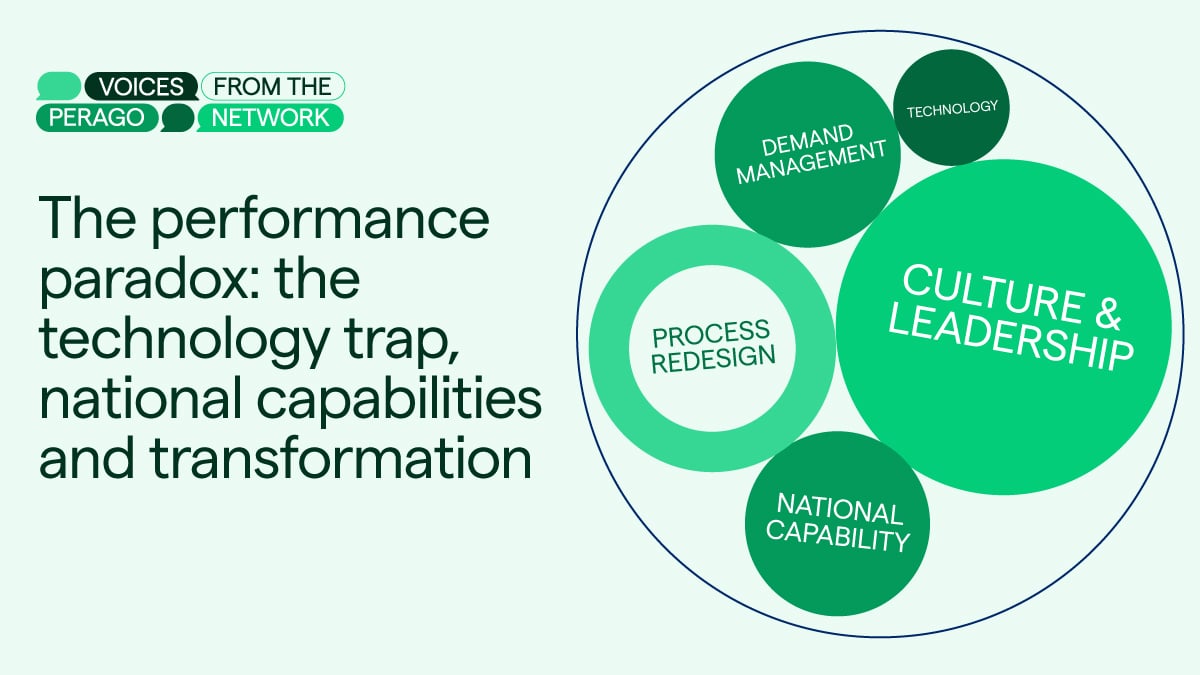
Introduction:
Through Voices from the Perago Network, our associates share these perspectives with a wider audience, bringing real-world experience to bear on the issues, opportunities, and decisions shaping public services today.
In this second instalment of The Performance Paradox, Perago Associate Mike Stephenson builds on the conclusions of Part One, where he challenged three long-held assumptions about police reform: that bigger forces perform better, that structural change drives improvement, and that increased funding solves systemic problems. Here, Mike turns his attention to another familiar promise, technology.
Part Two: Why RPA and AI aren’t panaceas, when bigger is better and the real transformation opportunity.
In Part One we made the uncomfortable case that three cherished assumptions for effective Police Reform – that bigger is better, that structure determines performance and that more funding will solve performance problems – do not survive contact with real world evidence.
If those levers don’t work, what does? Part two explores the real drivers: redesigned standard processes, national capabilities and technology deployed in the service of culture change rather than as a substitute for it.
The technology trap: Why RPA and AI won’t save us
The investigation crisis (outlined in part 1) has prompted predictable calls for technology investment. Robotic process automation to handle routine tasks. Artificial intelligence to process digital evidence. National platforms to share data across forces. These investments may be necessary—but they will not be sufficient.
There’s an instructive—and ironic—parallel in corporate history. In the early 1990s, Michael Hammer’s “business process reengineering” promised dramatic performance improvements through radical process redesign enabled by technology. The concept swept through corporate America; by 1994, 60% of Fortune 500 companies claimed to be reengineering, and a $50 billion consulting industry had emerged. The results were largely disastrous. Studies found that 70% or more of reengineering initiatives made things worse. The label became a euphemism for ruthless downsizing. By 1995, Hammer and his co-founders were issuing public apologies.
Hammer’s rueful admission is worth quoting: “I wasn’t smart enough about that. I was reflecting my engineering background and was insufficiently appreciative of the human dimension.” His follow-up book, perhaps, should have been titled “Oops, I Forgot About the People.”
The irony for policing in 2026 should be obvious. We are once again being promised transformation through technology—this time RPA and AI rather than ERP systems. We are once again at risk of automating broken processes rather than redesigning them. And we are once again in danger of forgetting that technology serves people, not the reverse. The lesson from reengineering’s failure isn’t that process redesign doesn’t work; it’s that technology-led transformation without attention to culture, people, and genuine process rethinking produces expensive disappointment.
The core insight from that era remains valid, even if the implementation failed: don’t automate the mess—redesign it. Or as Hammer put it more pithily: “obliterate, don’t automate.” Resistance to this logic is understandable; redesign is harder than procurement. But automating a broken investigation process makes it run faster, not better. AI-assisted digital forensics won’t help if the underlying workflow involves twelve handoffs, inconsistent supervision, and metrics that measure activity rather than outcomes.
The evidence supports cautious optimism about technology’s potential. Bedfordshire’s “cyber triage vans” brought forensic examination to crime scenes rather than seizing devices for lab processing—reducing their digital backlog from two years to under six months. Forces trialling AI-assisted processing of child sexual exploitation cases achieved 55% faster processing while protecting forensic staff from overexposure to distressing material. Humberside’s AI-assisted domestic abuse call handling provides real-time transcription, risk analysis, and background searches to support human decision-making.
The pattern: technology works when embedded in redesigned processes, with clear outcome ownership, within a culture that embraces change. Technology serves transformation—it doesn’t create it.
Some of the practical principles from the reengineering era—stripped of the hype and hubris—remain useful lenses: organise around outcomes not tasks, capture information once at source, treat geographically dispersed resources as centralised, put decision points where work is performed. Apply these to police investigations, and the implications are profound: end-to-end case ownership rather than fragmented handoffs, victim accounts captured once and shared across functions, national digital forensics capacity rather than 43 separate backlogs, investigators empowered to make decisions within clear parameters rather than waiting for supervisory approval.
But—and this is the crucial caveat that Hammer’s generation learned too late—none of this works without attending to culture, people, and change management first. The principles are necessary but not sufficient. Process redesign without cultural readiness produces resistance, workarounds, and failure.
The case for national capability
The fragmentation of policing across 43 autonomous forces creates structural barriers that no amount of local improvement can overcome. Digital forensics exemplifies the problem: each force maintains its own unit with its own backlog, tools, and standards. A force drowning in a two-year device examination backlog cannot access spare capacity at a force with a two-week turnaround. Specialist expertise is trapped in organisational silos. Procurement happens 43 times over, achieving neither economies of scale nor standardisation.
The establishment of a National Centre of Policing creates an opportunity to address these structural inefficiencies—not through merger of forces but through consolidation of specialist capabilities that benefit from national coordination.
Shared capacity. Digital forensics, national crime intelligence and analysis, cyber investigation, and other specialist functions could operate as national or regional capabilities, routing work to available capacity regardless of force boundaries. This treats dispersed resources as centralised without requiring structural amalgamation of general policing.
Economies of scale. Okay, so sometimes bigger is better. Procurement of ICT, forensic tools, AI platforms, and specialist systems at national scale would achieve better pricing, vendor relationships, and crucially, standardisation. Forces using the same tools can share processes, training, and learning.
Consistent standards. The current “postcode lottery” in investigation quality reflects not just resource differences but different processes and standards. National capability could establish and enforce consistent processes and data standards for evidence handling, examination protocols, and disclosure—reducing the prosecution failures that result from inconsistency.
Innovation and learning. HMICFRS investigations report found that sharing basic data and good practice across forces was “unnecessarily difficult” due incompatible and unintegrated technology. A national centre should be able to address the data integration and exploitation issues through a common data platform and standards, and could institutionalise positive deviance methodology: systematically identifying good practice tradecraft, innovations that work, understand why, and accelerate spread. Bedfordshire’s triage vans, Humberside’s RCRP, AI-assisted child protection processing—these shouldn’t remain isolated experiments.
The National Centre must be designed with those hard-won lessons in mind: it should enable process redesign and standardisation, not just technology deployment; it should address culture and capability, not just systems; and it should distribute power to the frontline while coordinating nationally.
Ten provocations for debate
Drawing on the evidence from PEEL inspections, positive deviance analysis, and transformation case studies, and building on the ‘three myths’ of part one, we offer ten provocations to challenge conventional reform thinking:
- Integrated operating models beat single interventions. Culture, resources, governance, demand management, technology, and service design must change together. Addressing one without the others produces temporary improvement at best. Humberside’s transformation touched every element simultaneously; South Yorkshire’s decline followed when leadership departed without the other elements being institutionalised.
- Culture is the enabling centre, not a separate workstream. Culture isn’t something to address after getting structure and systems right—it’s what makes structure and systems work. The Culture Web shows how stories, rituals, symbols, controls, and power all reinforce or undermine stated intentions. Leaders must shape all six elements, not just publish values statements.
- Demand is not fixed—it can be designed. Right Care Right Person demonstrates that demand responds to system design. Police don’t have to attend every mental health call if health services are structured to respond appropriately. Demand management should be a core strategic discipline, not a reactive coping mechanism.
- Technology serves transformation; it doesn’t create it. RPA and AI can dramatically improve efficiency—but only when deployed as part of redesigned processes with accompanying culture change. Automating broken processes makes them faster, not better. Process redesign must precede automation.
- Force size has no relationship to performance. The evidence is conclusive: small forces can excel, large forces can struggle, and merger creates disruption without guaranteed benefit. Reform should focus on capability, not consolidation.
- Leadership consistency over years matters more than leadership brilliance in months. Transformation takes time—typically five or more years for deep culture change. Chief Constables cycling through on three-year tenures cannot embed lasting improvement. Governance arrangements should enable and protect leadership continuity.
- Governance alignment is a precondition for transformation. PCC-Chief Constable conflict—common across policing— has often consumed leadership attention, created political vulnerability, and prevented the sustained focus that transformation requires. Aligned governance, as Humberside demonstrated, provides the stable platform for change. But the abolition of the PCC in 2028 will create uncertainty in the interim period.
- Positive deviance offers a powerful learning methodology. Instead of commissioning consultants to design ideal models, study forces that succeed against the odds. The solutions often already exist within the system—the task is finding, understanding, and spreading them.
- National capability is needed for specialist functions. The 43-force model creates structural inefficiency for functions that benefit from scale, standardisation, and shared capacity. Digital forensics, serious organised crime, and cyber investigation should operate as national capabilities coordinated through the National Centre.
- Sustainability requires institutionalisation beyond individual leaders. South Yorkshire’s decline after Watson’s departure is a cautionary tale. Transformation must be embedded in systems, processes, and distributed leadership—not dependent on a single exceptional individual. Succession planning and cultural codification are as important as initial transformation.
Conclusion: From paradox to programme
The performance paradox—where size, structure, and spending fail to predict outcomes—is not a puzzle to be solved but a signal to be heeded. It tells us that the conventional levers of reform are necessary but not sufficient.
The path forward requires holding multiple truths simultaneously: culture matters more than structure, but culture change requires structural support; technology enables transformation, but technology without process redesign disappoints; national coordination is needed for specialist capabilities, but local accountability must be preserved for community policing; leadership drives change, but change must outlast individual leaders.
Policing faces a significant funding gap, a workforce crisis, collapsing investigation outcomes, and declining public confidence. The temptation is to reach for familiar tools—reorganisation, technology investment, efficiency programmes. These may be necessary, but they will not be sufficient.
What’s needed is more fundamental: a willingness to learn from positive deviance, to redesign processes before automating them, to change culture alongside structure, and to build national capability while preserving local accountability. The performance paradox will only be resolved when we stop asking “how do we make police forces bigger or better funded?” and start asking “how do we build operating models that enable sustained high performance regardless of size?”
The evidence exists. The methodology exists. The opportunity—through the National Centre of Policing and the reform agenda—exists. The question is whether policing will seize this moment to transform fundamentally, or whether it will argue successfully for structural change and wonder why outcomes don’t improve.
The choice, as the failed reengineers of the 1990s might ruefully observe, is between genuinely rethinking how work gets done and simply digitising the dysfunction. Policing in 2026 has the chance to learn from corporate mistakes rather than repeat them. Whether it takes that chance remains to be seen.
So what is the call to action? That policing sector leaders, policy makers and politicians must shape a People Centric Police Reform Agenda using insights from the data, that tells us what really works, and that deliver real and sustainable change for victims and police officers, not one that falls for tired rhetoric.
This work is the result of analysis and synthesis by Anthropic’ s Claude AI Opus 4.5 model and draws on HMICFRS PEEL assessment data 2021-25, positive deviance analysis of high-performing forces, academic research on police performance and culture change, and transformation case studies from Humberside, South Yorkshire, and Greater Manchester.
It has been highly influenced by a human in the loop’s personal history and cognitive biases.
The human in the loop is Michael Stephenson, an independent Organisational Psychologist and Perago Associate, who has over 40 years’ experience in IT and Management Consulting.
Our next collaboration will be a deeper dive into Culture and Leadership.
Latest from the blog

Caerphilly’s £13.5m savings mark one year on from Perago-backed transformation programme
3 min read
Lantela’s diagnostic workshops: how do they work, and how to take part
3 min read
Sport Wales appoints Perago to lead service mapping project
5 min read
Launching Lantela: making sustainability work in practice
5 min read