Blog
BlogWales bet on contact centres. AI is reshaping them. We mustn’t lose the knowhow
6 min read Written by: Emma Northcote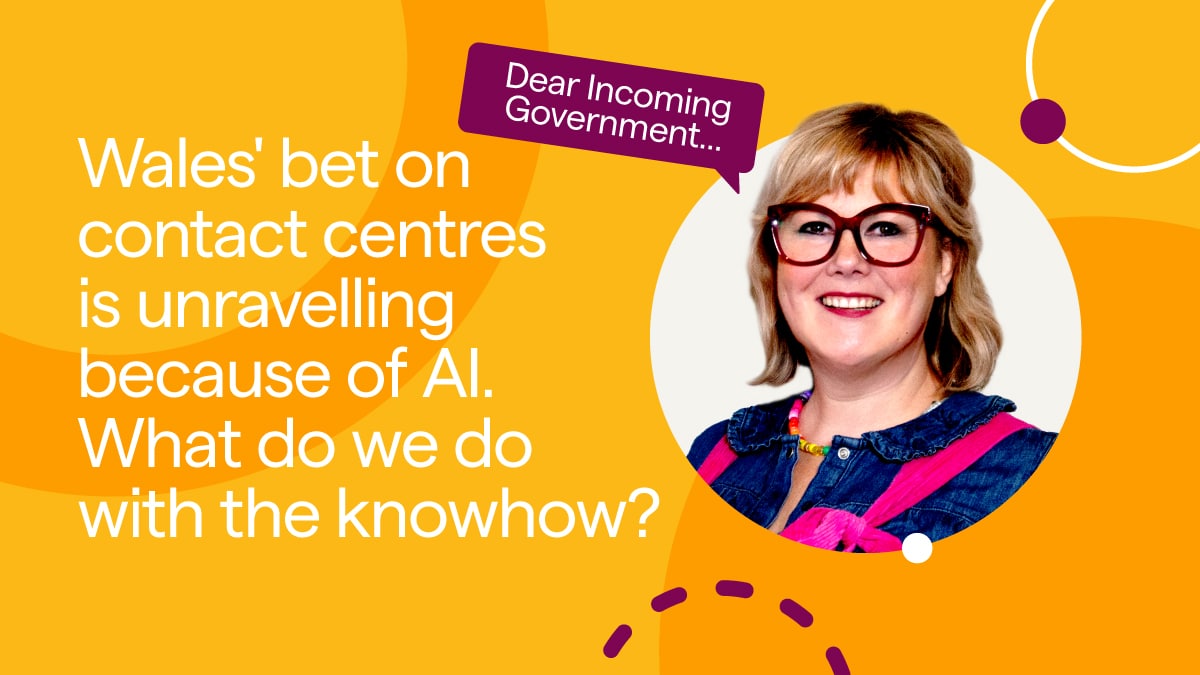
In her contribution to Perago’s ‘Dear Incoming Government’ series, Emma Northcote, Head of Engagement and Research at Perago, argues that the knowhow built up over decades in Wales’ contact centre sector is an asset worth redirecting. And that the harder question sits alongside it: what does government owe the people whose jobs were created by one era of policy and are now being reshaped by another?
It made sense at the time
As heavy industry wound down, call centres became a fairly achievable source of job creation in unemployment hot spots. Some might say the appeal of our friendly accents had something to do with it too. In areas like Swansea where we are based, nearly 9 in 10 jobs are now in the service industries, with an estimated 5,000 jobs in the call centre sector. Across Wales some 30,000 jobs are thought to be tied to call centres.
But the widespread adoption of AI is starting to make our over-reliance on call centres look a bit dicey as an economic development strategy. The Wales Economic and Fiscal Report 2025, presented by Welsh Government Chief Economist Dr Thomas Nicholls, explicitly flags automation and artificial intelligence as a growing risk for routine service roles.
There is a pattern here worth pausing on. One era of policy deliberately attracted call centres to Wales as a source of good service-sector work. A different era of policy, led from the same buildings, is now enthusiastically backing the technologies reshaping those same jobs. Neither decision was wrong in its context. But the people who responded to the first set of incentives are now on the wrong side of the second. That is not a hypothetical future problem. It is happening in Swansea, in Cardiff, in Merthyr, now.
So the incoming government inherits two linked questions, not one. What do we do with the knowhow these workers built up? And what do we owe the people themselves as the terrain shifts under them?
What thirty thousand people in Wales know and feel
Call centre workers, as a group, hold an extraordinary body of tacit knowledge about how Welsh public services and Welsh customers really work. Not the scripts. Not the KPIs. The real stuff: what callers are asking for underneath the question they say out loud, where the system breaks down in practice, how to de-escalate a situation before it tips into a complaint. Which cases need a human and which ones do not. Much of that is gut. You do not get it from training. You get it from years of conversations, and it stays in the people who had them.
That knowledge was not free. It was built over years, one conversation at a time. And it will not survive a standard redundancy programme. When routine calls are automated and headcount falls, the people with the most options leave first. Knowhow does not select for survival. There is no handover process for the tacit. When those people go, it goes with them.
We have seen this up close. When we worked with Caerphilly County Borough Council to help redesign their contact services, we found that between two people on that one project there was over sixty years of knowledge about council services. You cannot replace that. It was invaluable to understanding and untangling some of the challenges our small project team had, and it had real-life consequences for customers. That is what tacit knowhow looks like when you actually encounter it in the room. And that is what gets lost when a workforce contracts without anyone asking where the knowledge lives.
The question worth asking now, before the pressure is acute, is what happens if that knowhow is treated as an asset rather than a cost. The pattern emerging across public-service contact centres points the way. Natural-language AI is now handling the opening seconds of many calls, working out what the caller needs and routing simple queries straight to an answer. Published figures suggest the time spent in those automated layers has roughly halved. What has also happened, and this is the bit that matters, is that the conversations the human advisors are having have got harder. They are the calls that genuinely need a human. The complex ones, the vulnerable ones, the situations where a script would fail.
That is not a workforce being hollowed out. That is a workforce whose tacit knowledge has become more valuable, not less, because it is being concentrated on the cases that actually need it. Get the redesign right and the people who held the knowhow when the work was mostly routine become the senior layer of a service built around the work that is not. Get it wrong, treat it as a headcount problem, and the knowhow walks out of the door.
Redirecting knowhow inside an organisation is itself a piece of organisational design. The question becomes how to move skilled and committed people from parts of a business where demand is contracting toward parts where it is outstripping supply. That is not easy. It usually means retraining, and crossing internal boundaries where different pay scales and reporting lines have grown up over time. None of that is impossible, and the better Welsh organisations I have worked with do versions of it already. What it buys is time. What it does not do, on its own, is keep up with the pace at which the technology and the expectations around it are moving. The longer-term work, turning this into an opportunity rather than something we are constantly catching up with, sits alongside the redesign, not after it.
But the knowhow argument does not answer the whole question
Here is where I should be honest about the limits of the move I have just described.
Redirecting knowhow is the right response for the workers whose jobs evolve. It is not an answer for the workers whose jobs are simply gone. And at the scale AI is moving through the sector, there will be people in the second category as well as the first. Thirty thousand jobs is a lot of jobs. Not all of them have an obvious next step, and not all of the people in them want to be retrained as complex-case specialists or service designers. Some of them were happy doing what they were doing, and did not sign up for a career transition because a different era of technology policy arrived.
Which raises the question the incoming Welsh Government will genuinely have to answer. What does the state owe people whose livelihoods were shaped by yesterday’s policy choices and are being reshaped by today’s?
This is the territory it will be in, whether it chooses to be or not. Universal Basic Income. Sectoral transition funds. Serious retraining at scale, with genuine backing rather than the short-course patches that usually get offered. Shorter working weeks. Some combination. Each carries different costs, different politics, different evidence. I am not going to argue for any of them in this piece. I am going to say something narrower. The framing of the question is itself work, and it is the kind of work an incoming government rarely has time for in its first year, when the in-tray is full of things that have already gone wrong. The questions that have not gone wrong yet, the ones the public cannot yet see, are the ones that benefit most from being framed deliberately. That is what design thinking is for.
There is also a constraint worth naming. The largest interventions in this space, the ones with the most leverage on people’s livelihoods, sit at UK level. Wales is being asked to think through this territory without fully owning the spending tools. That is a fact about the settlement, not a complaint about it. It just means the design problem the incoming government inherits is harder than it would be elsewhere. More creative use of the levers Wales does control. Sharper choices about where to concentrate effort. A more rigorous read of where genuine devolved leverage exists. Design thinking is more useful in this kind of constraint, not less. It is how you make a smaller set of tools do more of the right work.
What I would say clearly is this. The cost of doing nothing, of letting the market run this transition on its own, is not zero. It is measured in local high streets, in the demand on NHS mental health services, in the kind of political disaffection that other countries have been living with for a decade. Wales gets to decide whether to treat that cost as someone else’s problem or its own.
It’s not just contact centres
Call centres are the clearest current example, but they are not the only one. Over the next decade, the incoming Welsh Government will face this question repeatedly, in sector after sector where deliberate policy built something that is now being reshaped by forces the original policy could not have anticipated. Retail. Logistics. Parts of professional services. Each time, the same choice will come up. Respond to the disruption as a cost problem, or respond to it as a knowhow problem.
The organisations that treat it as a cost problem will cut, save, and quietly lose something they invested years to build. The governments that treat it as a cost problem will save on the workforce line and pay the bill somewhere else, usually with interest. The ones that treat both questions seriously, and answer them in view of each other, will come out of this decade with a workforce and a country that still holds together.
This is the territory Perago works in
This is the territory Perago works in, and we would be glad to be useful in it at three layers. The first is the one I have just described: helping frame the question, build the evidence base, and articulate the choices in a form ministers and the public can engage with. Engagement and research is what I lead at Perago, and we have been listening to people inside Welsh public services for nearly a decade. The second is service design: whatever the intervention turns out to be, somebody has to design how it actually reaches the person it is meant to reach. How eligibility works. How the handoffs between agencies are built. How the service feels at the hardest point of a year nobody planned for. That is what the whole of this series has been about. The third is the closer-in version: redesigning workforce shape inside contact-centre operations themselves, so that the tacit knowhow built up over decades becomes the senior layer of a service built around the cases that actually need a human, rather than walking out of the door in a redundancy round. A ninety-day diagnostic. A focused redesign with a named team. Coaching the operational leaders who will live with the new shape long after we have left the room.
If you are leading an organisation thinking about what AI means for your workforce, or a part of government thinking about what comes next for the Welsh economy, we are always happy to talk.
Dear Incoming Government is a Perago series published in the run-up to the May 2026 Senedd elections. You can read the full series here.
Latest from the blog
Caerphilly’s £13.5m savings mark one year on from Perago-backed transformation programme
3 min read
Lantela’s diagnostic workshops: how do they work, and how to take part
3 min read
Sport Wales appoints Perago to lead service mapping project
5 min read
Launching Lantela: making sustainability work in practice
5 min read