Blog
BlogWales has most of the ingredients for public service reform. Here’s what’s still missing.
6 min read Written by: Omar Idris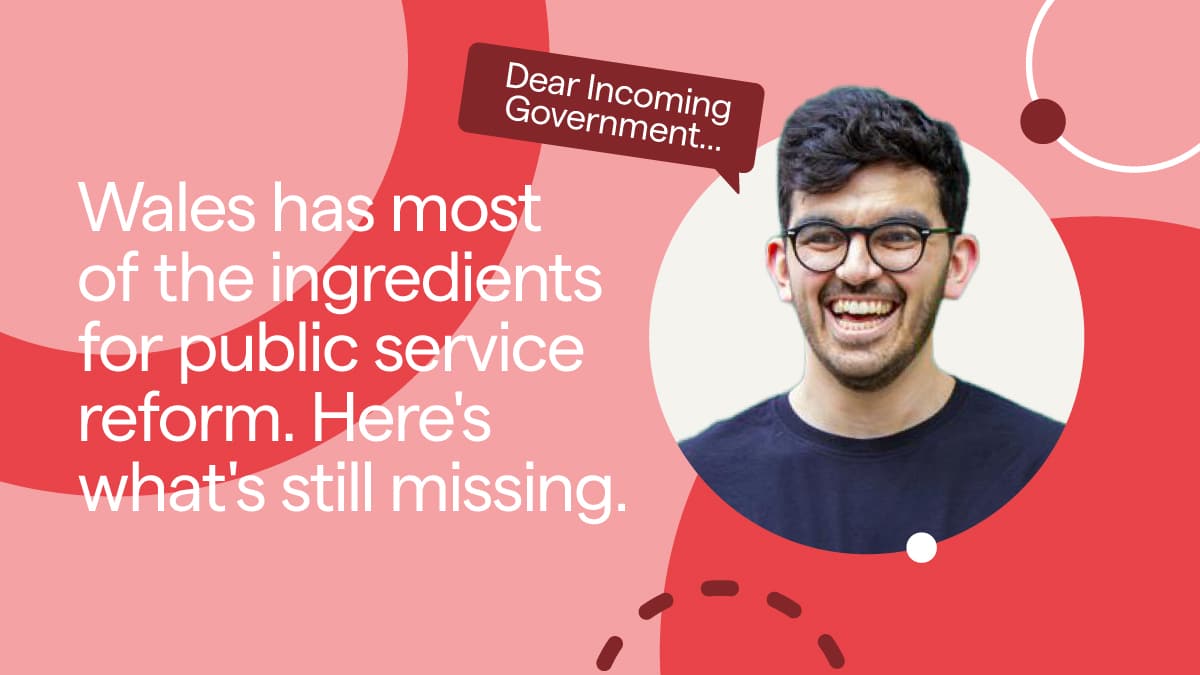
In his contribution to Perago’s ‘Dear Incoming Government’ series, Omar Idris, Head of Service Design at Perago, argues that Wales is at a genuine moment of possibility, but political will alone won’t be enough. The distance between policy ambition and lived reality isn’t a gap you can bridge with better communication. It’s a fracture that runs through the way policy gets made, and closing it requires us to create fundamentally different conditions.
Wales is at one of those rare moments when real change feels possible. A new Senedd, a fresh mandate and an appetite to govern differently. In a political moment defined elsewhere in the world by managed decline and lowered expectations, Wales has a real opportunity to show what ambitious, grounded public service reform can look like. It’s part of what drew me back to working more solidly in Wales at Perago.
And it’s precisely because this moment matters that it’s worth being honest about what could get in the way. Because there’s a pattern which is familiar to anyone who has worked inside government, and frustrating to most of them, that has a habit of absorbing even the most genuine ambition. The manifesto enters the machine, then somewhere between the policy White Paper and the lived experience of an actual person navigating an actual service, something essential gets lost. What worries me isn’t the appetite for change, it’s that we’ll mistake the desire for change for the solution, and assume political will is sufficient, when the harder question – ‘How do we make this work for real people, in real places?’ is still largely unanswered.
You can’t bridge a fracture
We’ve got comfortable describing the problem between policy and practice as a ‘gap’, as if it’s a distance you can bridge solely with better communication, a delivery unit or a programme board with the right terms of reference. The distance between a housing policy and a family in their first month in a B&B isn’t just a gap, it’s a fracture, which is systemic, structural and running through the whole way we make and deliver public policy, not just in Wales, but probably everywhere.
The fracture isn’t about competence, there are brilliant people inside Welsh Government, the NHS and local authorities working under impossible pressure, and with the right will to have positive impact. The fracture is about how and where policy gets made, and from whose experience of the problem you are developing it from. When you write an economic strategy insulated from the foundational economy it’s trying to fix, the one running on low wages, care work and seasonal tourism, you lose something. What you lose is knowledge that doesn’t travel through briefing documents, it only arrives through contact with reality.
The fracture is also systemic in a second sense: these challenges aren’t discrete problems needing better execution. They’re complex and interconnected. The housing crisis isn’t a planning problem or a funding problem or a land problem. It’s all of those things and more, interacting at different scales, all at the same time, in ways no single policy lever can fully address. These problems require a variety of solutions by actors inside and outside government, joined up across the whole system, and enabled by good policy and design practices.
A different relationship with reality
What I mean by policy + design goes beyond the workshops and the frameworks and beyond asking an LLM to solve it for us. It might be some of that at different points in different ways, but ultimately, it’s something more demanding and more honest. It’s that policy and prototypes (iterative versions of those policies) need to evolve together, not sequentially. Make the policy tangible early, get it in front of people it affects, in the places it’s supposed to work – working with those places, not just within them – watch what happens, and let that feedback into the policy itself, then repeat until you feel confident it is having the desired impact. The point isn’t that every solution or policy should be totally different in every place, it’s that local context produces better design, and better design scales.
These kinds of approaches are consistently talked about across the sector and practice, from places like Nesta through to broader agile design and delivery in both public and private sectors. The Test, Learn and Grow programme does this well in the context of public policy design, mainly focussed on how to deliver against the Westminster government’s mission priorities. It creates structured permission to be uncertain and asks teams to find out what works in real places, with real people, under real constraints, and bring that learning back into policy area rather than defending the original design. Wales has no national equivalent to this for devolved policy areas, which isn’t a criticism, but a question worth answering as we enter the next government.
On the other hand, Wales does have something that makes this way of working particularly worth trying here. A genuinely coherent policy jurisdiction: twenty-two local authorities, a single government, a legislative framework in the Well-being of Future Generations Act that already asks institutions to think long-term, prevent problems and involve citizens in decisions. That means a Welsh test and learn programme wouldn’t be starting from scratch, it would be building on foundations that already point in the right direction. Some of the structural conditions for joined-up, place-based learning are strong here, ready to be built on.
The intelligence to make this work isn’t missing; it’s already there – in the housing officer, the teacher, the GP, the health visitor, and the community energy project all waiting to be noticed. The question is whether we build the conditions for that intelligence to flow to and from the centre, or whether it stays trapped at the front line, while policy is made at the top.
What it takes
The hardest part isn’t making the commitment to do this; it’s building what makes the commitment real. This is where good intentions usually meet reality. Which isn’t because governments are cynical, the people involved genuinely want to work differently. The conditions that make it possible are harder to build than the commitment is to make. A team gets set up, some pilots get celebrated, and then the budget tightens, a minister changes, a crisis absorbs the bandwidth, and the whole thing quietly narrows, often not through any single decision, but through the accumulated weight of competing pressures on the system’s time. The language of experimentation survives; the space to experiment doesn’t. The people who were starting to believe it notice, and that culture you’ve been trying to build quietly unravels
Real commitment needs two things working together. The first is structural: protected funding over a long enough horizon to develop roots, dedicated capacity and people whose job is to do this day-in-day-out, and air cover from leaders willing to stand in front of a committee and say, “we tested this, we learned, we adjusted”, rather than retreating the moment something imperfect lands in public. A structured, test and learn programme of work for better policy design in Wales.
The second is organic: creating the conditions for this to spread because people want it to. The most durable change doesn’t come solely from top-down mandates: it comes from a team in Gwynedd telling their colleagues about something that worked, a policy official who spent a week on the front line and came back changed, a small pilot that got noticed and scaled. That’s how things also travel, person to person, slowly at first, then suddenly moving across everything, everywhere, all at once. This happens through a combination of structural commitment to a national test and learn programme for Wales, underpinned by the conditions for learning to travel across the country organically; communities of practice, support scaffolding for how to do this work, upskilling programmes, space to share best practice under one banner.
Wales is well placed for this. Small enough that there are only a few degrees of separation between a member or minister and a front-line worker, big enough that what works here is visible, transferable, and nationally significant. There aren’t many places where you can genuinely test, learn and change things at national scale – Wales is one of them.
All of this requires a different kind of courage from the one that leads with announcements. It is the courage to fall in love with the problem before falling in love with the solution. Wales deserves more than announcements about doing things differently. It needs the conditions that make different things possible, then the will to back them properly.
At Perago, we work in Wales because we believe it’s one of the most interesting places in the UK to try to make public services better. We’ve also been doing this work, across Wales, long enough to know what it takes to make things happen, and where things tend to get in the way. If the next Welsh Government want to think seriously about embedding test and learn into how policy or services get developed in Wales, and building a programme of test and learn work, we’re ready to be part of it.
Dear Incoming Government is a Perago series published in the run-up to the May 2026 Senedd elections. You can read the full series here.
Latest from the blog
Caerphilly’s £13.5m savings mark one year on from Perago-backed transformation programme
3 min read
Lantela’s diagnostic workshops: how do they work, and how to take part
3 min read
Sport Wales appoints Perago to lead service mapping project
5 min read
Launching Lantela: making sustainability work in practice
5 min read