Blog
BlogNHS Wales is carrying a heavy load. Here’s what would lighten it
6 min read Written by: Cory Hughes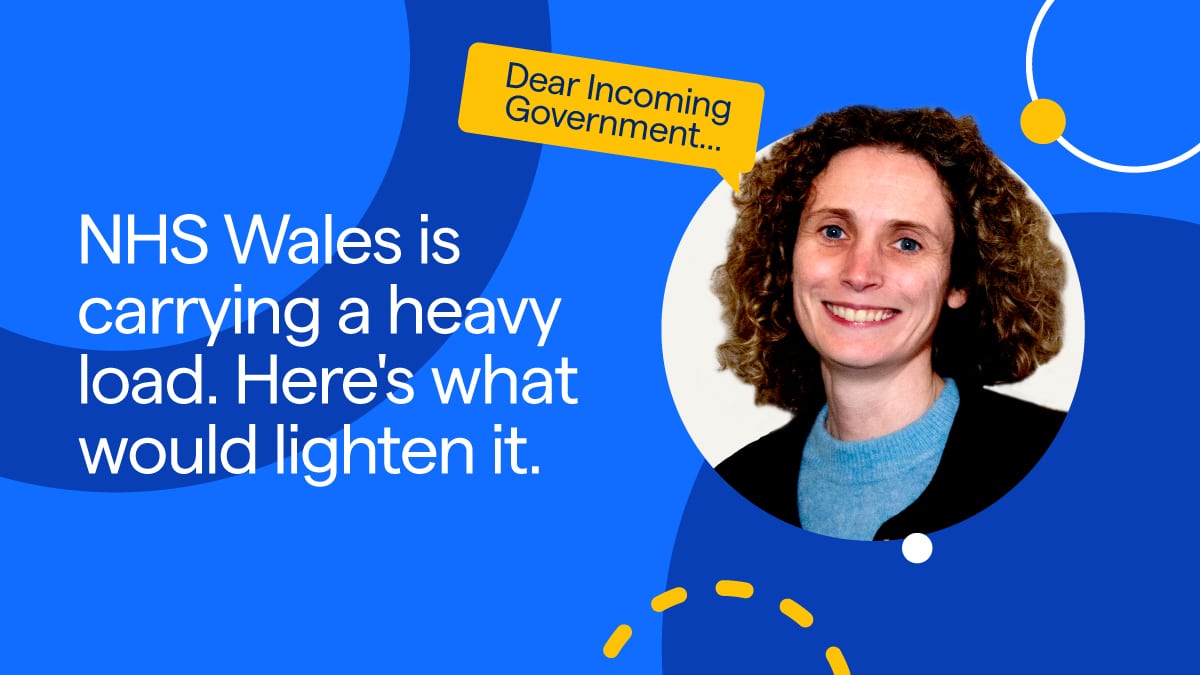
In her contribution to Perago’s ‘Dear Incoming Government’ series, Cory Hughes, Director of Strategic Design, argues that Welsh health services are working under extraordinary pressure with foundations that haven’t been looked at properly in years. The ambition is there. The legislation is there. What’s missing is the protected time and resource to ask the basic questions: do we know how our services actually work, and do we have the right people and tools in the right places? The incoming government has a specific, practical opportunity to change that.
There is a person I keep thinking about. She lives in rural Wales. She has been in hospital, she is well enough to go home, and the bus that will take her there leaves at 5pm. Whether she makes that bus with her prescribed medication depends on a chain of decisions and system handoffs that nobody in the building has ever mapped end to end. A discharge note. A pharmacy queue. A transport request. A system that was procured years ago for a different organisation entirely. Most days the chain holds. Some days it might not.
I think about her because this worst-case scenario is an unintended consequence of a question that does not get asked often enough inside Welsh public sector organisations. Not a strategy question, or a transformation question, or a targets one. A more human one. Do we understand the complete picture of how our services work? How they are supposed to work on the page compared with how they work in the real life of the people delivering them and the people relying on them?
In the service design workshops I have facilitated over the last few years alongside nurses, pharmacists, medics and digital staff, that question has landed in a particular way. It is not overly surprising. The people in the room know more intimately than anyone where the handoffs might stall. They know which requests take the longest time to fulfil and what it would take to remove stress from the patient’s experience. When they sit together in the same room, there is a collective knowledge that can be combined to surface pain points and develop solutions that would make a real difference in practice.
This is the foundational layer of any health service. It is also, in my experience, the layer that requires dedicated time to explore but is often out of scope. And I want to be clear about why: the people inside these organisations care deeply, and they are holding the roof up in ways that are genuinely exhausting. There is always something more urgent. A waiting list. A winter. A reorganisation. The foundational questions get deferred, the deferred question accumulate, and eventually the organisation is carrying a weight of unexamined infrastructure that nobody quite owns, and nobody alone can fix.
That is not a criticism. It is a description of what it costs to keep a health service running under the pressures Wales is currently facing. Anyone who has worked inside an NHS organisation knows the feeling of being so consumed by today’s interconnected crises that the complex and delicate work of visualising how the system operates from the outside in never quite gets the attention it deserves.
What we find when we look
In our work with a Welsh NHS organisation that was willing to ask the foundational questions of their digital transformation initiatives, we did not start with a strategy. We started with the fundamentals. How is the team resourced to meet demand? How do requests for new work come in? How are they assessed and prioritised? What do the people who depend on that team understand about the value it can bring and how to engage with it to drive outcomes?
What made this engagement work was that the organisation commissioned the honesty. They wanted to understand their current state before designing their future one. Working through service mapping workshops with multidisciplinary teams, we were able to surface the real picture. Not the process as it was drawn on paper, but the process as people experienced it. Where the handoffs broke down. Where handwritten requests required double-checking. Where the rural Wales patient relying on that five o’clock bus to get home depended on a chain of decisions that had never been looked at end to end.
That is not a technology problem. It is a design problem.
The outputs pointed in a clear direction. A clearer picture of how demand flows. A set of problem statements that everyone in the room could recognise as true. A roadmap that started with what needed fixing now before moving to the longer-term work. But surfacing that picture required something beyond a series of workshops. It required the organisation to look at how it worked alongside how it was intended to work. That is a cultural shift as much as a design one. Getting multidisciplinary teams into the same room, asking them to map reality alongside aspiration, and then acting on what they find, takes trust, time, and leadership willing to sit with uncomfortable answers. That is not a one-off exercise. It is a way of working that needs to be built and sustained.
The questions every health organisation should be asking
We see the same pattern consistently across Welsh public services. Organisations are asked to transform without first understanding what they are starting from. The foundational questions get skipped because there is no protected time to ask them, not because people do not want to.
Do we have the right people in the right roles? Not the roles on the organogram. The roles that reflect how the work gets done today.
Do we have the right tools? Not the systems that were procured years ago. The ones that staff are using, and the gaps where workarounds have quietly filled the space.
Are the people closest to the work being heard? The clinicians, the nurses, the digital staff who know where the system strains. Their knowledge is the most accurate information available about how the service operates.
These are not comfortable questions to ask when you are also running a waiting list. But they are the questions that make transformation more likely to succeed.
What the incoming government should do
The ask here is specific. Make foundational service design a condition of transformation funding. Before a health board or NHS body receives investment in a new programme, require a time-limited service design review: map how the priority service works, identify where the friction sits, establish whether the right people and tools are in the right places. Not a lengthy commission. A focused piece of work with a named team and a clear output. Make it a milestone, not an optional extra.
Wales already has the legislative framework for this. The Well-being of Future Generations Act asks public bodies to work in an integrated, preventative, and collaborative way. The five ways of working are not aspirational. They are a practical design brief. The question is whether health organisations are given the protected time, resource, and permission to apply them at the foundational level, not just the strategic one.
We have done this work across Welsh public services. The pattern is consistent and the method is not complicated. What is harder is creating the conditions: protecting the time, backing the process, and acting on what it finds even when the findings are inconvenient. That is the real ask of the incoming government. Not more ambition. Wales has that. The infrastructure to act on it at the level where it matters most.
If the next Welsh Government wants NHS Wales investment to go further, make the foundational work a prerequisite, not an afterthought.
Dear Incoming Government is a Perago series published in the run-up to the May 2026 Senedd elections. You can read the full series here.
Latest from the blog
Caerphilly’s £13.5m savings mark one year on from Perago-backed transformation programme
3 min read
Lantela’s diagnostic workshops: how do they work, and how to take part
3 min read
Sport Wales appoints Perago to lead service mapping project
5 min read
Launching Lantela: making sustainability work in practice
5 min read